New GH2 report on blue hydrogen and derivatives in Japan and South Korea: Calling for transparency to ensure credible climate performance
Although blue hydrogen and ammonia projects have faced setbacks globally due to the spike in natural gas prices triggered by the US–Iran war, some major projects are still moving ahead and require careful monitoring. In Japan and South Korea in particular, public finance is being committed to blue projects based on standards that leave large shares of life-cycle emissions unmeasured and undisclosed. This creates significant risks of greenwashing and inflated climate credentials.
GH2’s latest report examines the existing low-carbon hydrogen standards in Japan and South Korea, which follow ISO 19870, and argues that they remain insufficient to accurately measure emissions from blue projects. Drawing on the IEA database and other publicly available sources, GH2 reviewed nine projects including import projects from the US such as the Blue Point Facility, and domestic projects such as the Boryeong Terminal and the Changwon City project. GH2 found that their climate performance cannot be credibly assessed due to a lack of publicly available information. Greater transparency and accountability are needed to prevent greenwashing. Without robust standards and transparent reporting, public funding risks supporting projects that lock in fossil fuel assets without delivering meaningful emissions reductions.
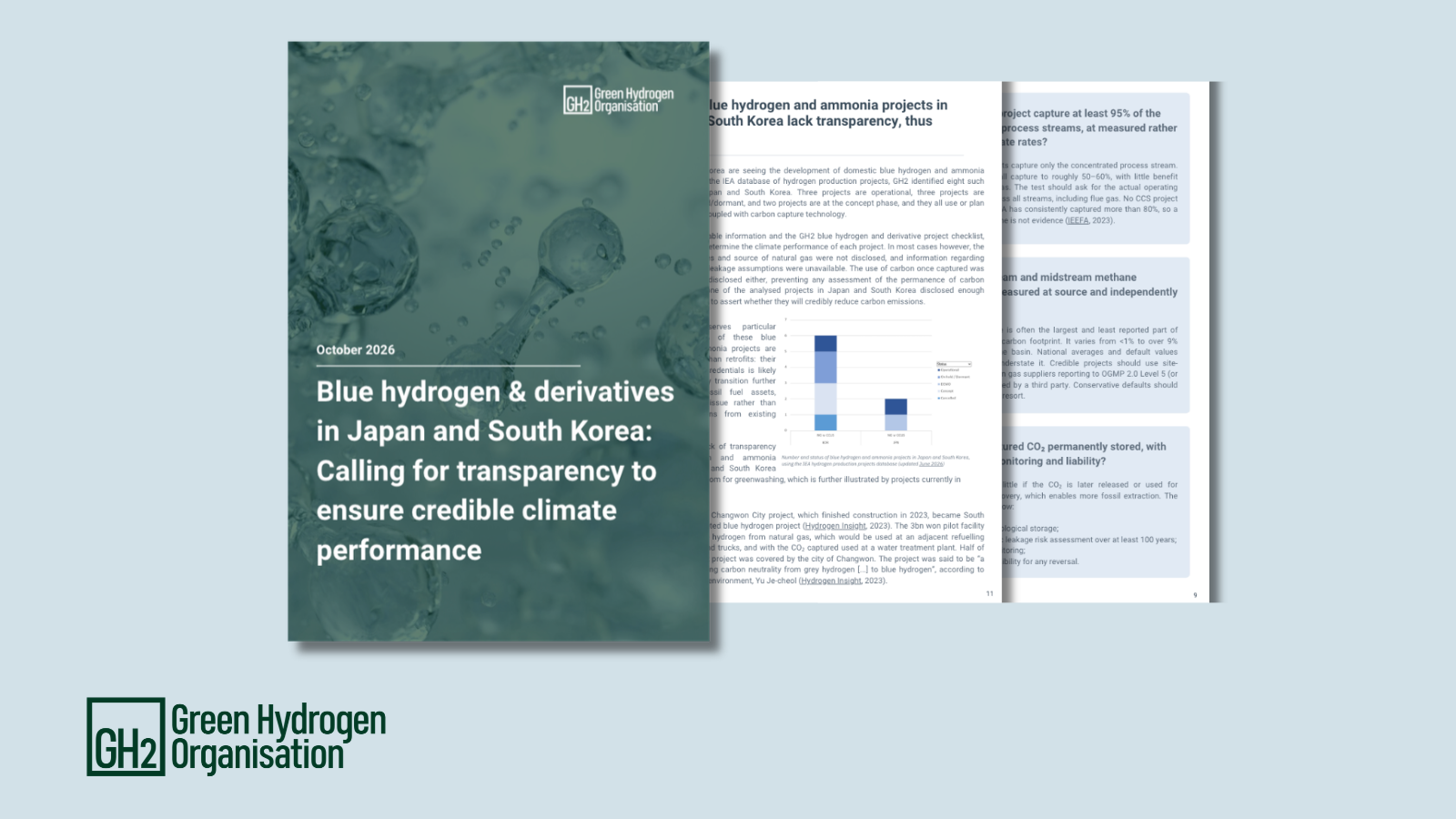
Read the full version of Blue hydrogen & derivatives in Japan and South Korea: Calling for transparency to ensure credible climate performance here.
Public funding must deliver credible emissions reductions
Public support for blue hydrogen and ammonia should focus on decarbonising existing fossil hydrogen production, rather than creating new demand for natural gas. As the report argues, this is the only case in which blue hydrogen and ammonia can meaningfully reduce emissions.
To ensure credible climate performance, GH2 has set out six key questions in its blue hydrogen and derivatives project checklist, which projects must answer positively. These questions ensure that blue projects demonstrate high carbon capture rates across all process streams, low upstream and midstream methane leakage, and permanent, monitored geological storage of captured CO₂.
The checklist also requires emissions to be measured across the full life cycle, including natural gas extraction and transport, hydrogen and ammonia production, and the transport and storage of captured carbon.
Independent verification and transparent disclosure should be conditions for receiving public funding. No project should receive public subsidies without independently verified data on capture rates, methane leakage, the source of natural gas, carbon storage and use, and life-cycle emissions intensity.
Aligning public funding with climate goals and energy security
GH2 highlights the risks of deepening Japan’s and South Korea’s dependence on volatile liquefied natural gas (LNG) markets. Imported fossil fuels already account for 87% and 81% of their respective energy needs. Rather than reinforcing this dependence, public funds should shift towards renewables and green hydrogen for hard-to-abate sectors, strengthening energy security while meaningfully contributing to industrial decarbonisation.
Recent policy developments offer an opportunity to reconsider priorities. South Korea has excluded low-carbon ammonia imports for coal co-firing from its public auction, while Japan has reconsidered its policy and related budget allocations. These are welcome steps away from co-firing and towards a more credible approach to decarbonisation.
Ultimately, public funding should support projects that deliver credible emissions reductions, rather than compound the climate crisis by delaying the transition. By prioritising domestic renewables and green hydrogen projects, Japan and South Korea can reduce their reliance on volatile fossil fuel imports, strengthen their energy security and take meaningful steps towards their climate ambitions.
Five recommendations for Japan and South Korea
GH2’s report outlines five key recommendations to ensure that blue hydrogen and ammonia projects deliver credible emissions reductions and that public funding supports meaningful climate action.
1. Limit blue hydrogen to decarbonising existing production. Public support should prioritise carbon capture retrofits on existing grey hydrogen and ammonia production, rather than creating new demand for natural gas. New projects that add to natural gas demand should demonstrate high performance against robust climate criteria.
2. Measure emissions across the full lifecycle. Standards should cover emissions across the full value chain, including LNG shipping, hydrogen and ammonia production, ammonia cracking, and the transport and storage of captured CO₂. Methane leakage rates should be based on measured, independently verified data to ensure that projects’ climate impacts are accurately assessed.
3. Make verification and disclosure a condition of public funding. Japan and South Korea should require independently verified lifecycle emissions data and transparent reporting for projects receiving public support. This should include projects supported under Japan’s Contracts for Difference (CfD) scheme and South Korea’s Clean Hydrogen Portfolio Standard, ensuring that public funding goes to projects with credible climate credentials.
4. Ensure that there is no grandfathering. Projects certified today should not retain their status if standards are tightened in the future. Existing projects receiving public support should also be reviewed against robust climate criteria to reduce the risk of greenwashing and ensure credible emissions reductions.
5. Secure the shift away from co-firing. Public funding should be redirected towards sectors where hydrogen and ammonia can make a greater difference, such as fertilisers, shipping and steelmaking, including imports of green iron. Co-firing offers limited potential to reduce emissions and risks diverting resources from more effective decarbonisation solutions.
Together, these recommendations would help ensure that public funding supports projects that deliver credible emissions reductions, strengthens energy security and contributes to meaningful progress towards decarbonisation in Japan and South Korea.
Flore Schmerber,
Policy and Research Associate, GH2